
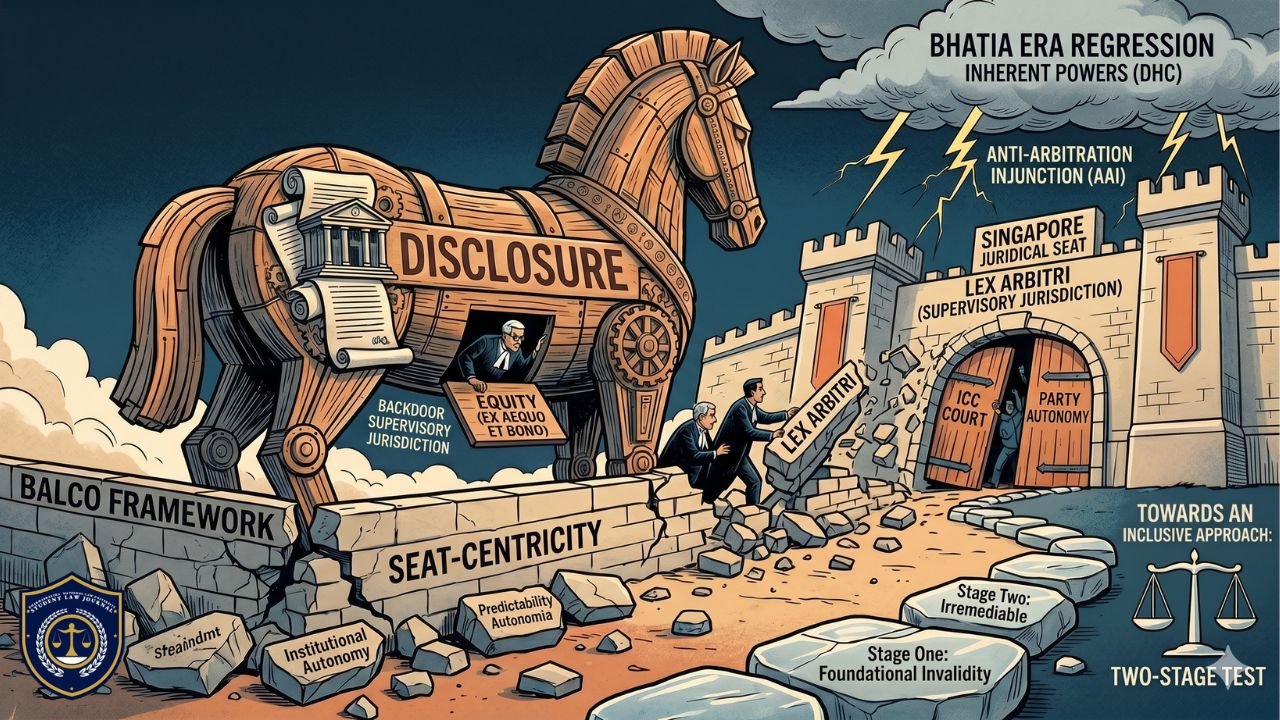
Epi’s Trojan “Disclosure” Horse: Ex Aequo ET Bono Intervention or Backdoor Supervisory Jurisdiction?
INTRODUCTION
“The court’s role is containment, not control & ensuring that the promise to arbitrate is kept, pacta sunt servanda.”
Quoted by Justice Foxton
It was assumed settled that the anti-arbitration injunction [“AAI”] by Indian courts is impermissible where the seat is foreign, and that the mere presence of Indian law, whether as the lex contractus or being the law governing the arbitration agreement [“LGAA”], will not confer supervisory jurisdiction.
However, the Delhi High Court’s [“DHC”] decision in Engineering Projects (India) Ltd v MSA Global LLC [“EPI”] unsettles this foundation by granting an AAI against a Singapore-seated ICC arbitration based on an arbitrator’s alleged non-disclosure. In EPI, the DHC treated Article 11(2) of the ICC Rules of arbitration as a subjective disclosure obligation triggered by what may be in the “eyes of the parties” as a ground for judicial intervention, without acknowledging that only Article 14’s objective “justifiable doubts” standard governs disqualification.
This blog argues that EPI is troubling not merely because it misreads the ICC disclosure regime, as recent commentaries have noted, but because by elevating a non-disclosure expressly found to be “regrettable but not disqualifying” into a ground for judicial intervention, the DHC weakened institutional autonomy, unsettled seat-centric supervision, and diluted the exceptional nature of AAI.
(MIS)APPLICATION OF THRESHOLD?
The dispute arose on a border security system’s contract between an Indian Public Enterprise & an Omani Company. Arbitration initiated under ICC rules, along with Mr. Andre Yeap being appointed as the co-arbitrator by the Omani company. After commencement of the proceedings, the Indian party alleged non-disclosure of Mr. Yeap’s prior involvement in an unrelated matter connected to the respondent’s Managing Director (DHC Order, ¶ 4-9). Non-disclosure was challenged before the ICC Court of Arbitration & was rejected by ICC, then a plea before the Singapore High Court [“SGHC”] was made, under the UNCITRAL Model Law (SGHC Order, ¶41-45).
SGHC granted an anti-suit injunction to restrain the proceedings before the DHC (SGHC Order, ¶14-15), despite the SGHC order, DHC held the suit to be maintainable & granted an AAI. the Court applied litmus tests to assume curial supervision over a Singapore-seated arbitration & treated non-disclosure as oppressive (DHC Order, ¶104, 120). In doing so, it blurred the distinction between impartiality & disclosure, categorically expanded the jurisdiction of the Indian courts into the seat-court’s jurisdiction, and undermined party autonomy and institutional challenge mechanisms chosen by the parties.
The reasoning of DHC in EPI reflects a fundamental misapplication of the ICC rules governing disclosure & impartiality. Although the court acknowledged that ICC Court found the arbitrator’s non-disclosure to be “regrettable but not disqualifying” (¶82), it nonetheless treated the omission striking at the “root of the process” (¶¶81, 83), rendering the arbitration “oppressive” & “vexatious” (¶¶85, 90, 101). This marked a decisive shift from the ICC’s objective assessment to the claimant’s subjective perception (¶68), constituting the Court’s first misapplication of ICC rules.
The second error was treating disclosure, independence, & impartiality as the same. While Article 11(2) adopts a subjective standard test for disclosure, whereas impartiality is judged by an objective reasonable test as also explained by ICC’s Secretariat Guide. By blurring this distinction, the DHC extended the disclosure standard to assess the impartiality improperly transformed non-disclosure into a proxy for bias, contrary to ICC policy
A further misstep arose from collapsing Article 11’s disclosure obligation into the Article 14 challenge standard. Article 14 requires “justifiable doubts,” an objective threshold mirrored across institutional rules like 26.1(a) of SIAC Arbitration Rule, 2025 & Art 10.1 of LCIA Arbitration Rule, 2020. While the ICC Court correctly applied this standard (¶78), the DHC instead referred to “legitimate doubts” in the claimant’s mind (¶101), effectively bypassing Article 14 altogether and blurring the carefully calibrated distinction between transparency and disqualification. Even the ICC Note on Conduct of Proceedings, 2021 (at ¶ 26, p. 6) states that solely non-disclosure cannot be a ground for disqualification.
Finally, the DHC overlooked the ICC Court’s factual findings demonstrating why justifiable doubts did not arise. This architecture is mirrored in the 2024 IBA Guidelines on Conflicts of Interest. Paras 3.1.3 & 3.1.5 of IBA Orange List, identify the situations that warrant disclosure but do not, without more, justify disqualification; the Red List identifies relationships that render an arbitrator ineligible.
The prior appointment relied upon in EPI a single, four-year-old engagement by the respondent’s managing director falls (¶79), at most, in the Orange List category. Treating a failure to disclose an Orange List circumstance as if it were a Red List disqualification blurs the carefully maintained gradation between “must disclose” and “must resign” that underpins modern conflict-of-interest regimes.
International practice recognises that such circumstances do not indicate predisposition. By characterising & picturing the omission as deliberate & incurable (¶¶81, 90), the DHC adopted an unduly fatal approach, collapsing disclosure into direct disqualification & departing from settled ICC order grounded in objectivity & a reasonable approach.
SEAT, SUPERVISION, & THE LIMITS OF EQUITY
The difficulty in EPI lies in the DHC’s assumption of supervisory control over a Singapore seated arbitration through the language of equity & oppression. This is at odds with the post-BALCO framework, where the seat functions as the source of juridical source of exclusive supervisory jurisdiction.
The Seat as an Exclusive Jurisdictional Anchor
At a conceptual level, the “seat” of arbitration is not merely a geographical designation but an anchor that determines the Lex Arbitri, the procedural law governing the arbitration and identifies the courts vested with supervisory authority, which in Latin is . Now, this seat-centric framework serves a critical function as it exclusively allocates curial jurisdiction to a single national legal system, thereby avoiding concurrent supervision and conflicting judicial outcomes. In short, choice of seat operates as a form of implied exclusive jurisdiction clause ensuring respect for party autonomy in transnational dispute resolution.
Since Bharat Aluminium Co. v. Kaiser Aluminium [“BALCO”], it has been settled that the seat of arbitration functions like an exclusive jurisdiction clause, giving supervisory controlling powers only to the courts of the seat (Balco, ¶ 121). In the case of Indus Mobile Distribution v. Datawind, this position was again reaffirmed & DHC held that once parties choose the seat, all supervisory powers including interim reliefs also is with the seat courts exclusively.
Seat-centric approach has already been weakened by recent SC rulings. In Disortho S.A.S. v. Meril Life Sciences Pvt. Ltd. [“Disortho”], a three-judge Bench appointed an arbitrator under Section 11 on the basis that Indian law was the law governing the arbitration agreement, despite the agreement providing for arbitration in Bogotá under Colombian institutional rules and law.
By conflating the lex contractus with the lex arbitri, Disortho opened an additional pathway for Indian courts to exercise curial functions including appointment and, by implication, removal of arbitrators without first ascertaining India as the juridical seat. Read together with Arif Azim v. Micromax, this marks a drift from BALCO’s territorial discipline towards a more amorphous, connecting-factor-based jurisdiction.
In EPI, the seat was Singapore. Consequently, all questions concerning tribunal constitution, arbitrator independence, disclosure, and procedural fairness fell squarely within the supervisory remit of the SGHC under the Model Law. That jurisdiction had not merely attached in theory; it had been actively exercised. The SGHC had entertained EPIL’s challenge and granted an anti-suit injunction restraining the Indian proceedings. Yet, the DHC proceeded to adjudicate the same issues, effectively positioning itself as a parallel curial authority. This is not a benign overlap; it is a direct contradiction of the seat principle.
Equity as a Trojan Horse for Supervisory Control
The DHC justified its intervention by invoking Sections 9 and 151 of the Civil Procedure Code, 1908, characterising MSA’s conduct as vexatious & oppressive in nature. This very approach mirrors the pre-BALCO style of judicial intervention & draws on ONGC v. Western Co. of North America, a decision rendered from the pre Bhatia International era, where Part I of the act was assumed to apply even over the foreign-seated arbitration.
However, the reliance over the ONGC v. Western Co. of North America is quite misplaced. The case dealt with restraining the enforcement proceedings to prevent oppression, not with supervising the internal procedure of an ongoing foreign-seated arbitration proceeding. Post-BALCO, SC consistently held the inherent or equitable powers cannot be used at all to interfere with foreign-seated arbitrations merely just cause of parties were Indian or Indian law was involved.
Indeed, in World Sport Group v. MSM Satellite, the Court refused to grant an AAI in a Singapore-seated arbitration even in the face of fraud allegations, holding that such objections must ordinarily be addressed by the arbitral tribunal or the seat court. The contrast with EPI is stark: if allegations of fraud do not justify intervention, it is difficult to justify an injunction based on a disclosure lapse already examined and rejected by the ICC Court.
By treating a mere disclosure lapse as making the arbitration oppressive, the DHC assumed jurisdiction over a foreign-seated arbitration, despite the ICC Court’s order, along with the seat court’s jurisdiction. Equity thus became a tool for intervention rather than a limited safeguard.
Regressing to the Bhatia Era Through Residual Powers
EPI risks resurrecting the very uncertainty that BALCO sought to bury. If Indian courts may issue AAI in foreign-seated arbitrations whenever conduct is framed as “oppressive,” the seat principle becomes porous, contingent, and discretionary. While the Single Judge emphasised Kompetenz-Kompetenz and statutory restraint, the Division Bench relied on inherent powers to intervene in a Singapore-seated emergency arbitration. EPI follows the latter path, normalising inherent jurisdiction as a substitute for statutory supervisory authority, precisely the instability that plagued Indian arbitration during the Bhatia years.
Moreover, as seen in Devi Resources v. Ambo Exports, such injunctions are often practically ineffective internationally (Devi, ¶¶ 56, 62-63). Tribunals seated abroad may proceed ex parte; awards may still be rendered; and the only tangible impact of the injunction is domestic arming the enjoined party with a future public-policy objection at the enforcement stage. This converts AAI into strategic tools rather than genuine remedies, encouraging tactical litigation and forum shopping.
The post-BALCO settlement does not deny Indian courts all power. It merely confines that power to its proper stage and forum. Courts may intervene at the enforcement under Section 48, or refuse the reference under Section 45 in narrowly defined circumstances. What they may not do is assume ongoing supervisory control over a foreign-seated arbitration under the guise of preventing oppression.
Whereas EPI uses equity and “oppression” to expand supervisory reach, Disortho does so by treating the Indian governing law of the contract as a sufficient hook for curial jurisdiction. Both decisions, albeit through different doctrinal routes, weaken the idea that the seat is the exclusive anchor of supervision and risk, resurrecting the very uncertainty that BALCO sought to bury.
By disregarding this boundary, EPI dilutes the normative force of the seat, weakens institutional autonomy, and unsettles the predictability that international arbitration depends upon. If sustained, it risks signalling that India’s commitment to seat-centric arbitration remains conditional & revivable whenever equity is invoked.
OWARDS AN INCLUSIVE APPROACH
Firstly, courts ought to treat ICC Article 11 disclosures as prudential transparency devices, not as freestanding triggers for judicial supervision. Challenges to the constitution of the tribunal must be measured, in the first instance, against the objective “justifiable doubts” standard in Article 14 and the outcome of the institutional challenge process. Secondly, AAIs should be granted only where a claimant satisfies a structured two-stage, seat-respecting test that confines court intervention to truly exceptional cases and avoids converting routine disclosure lapses into tactical weapons.
That restraint aligns with established limits on court intervention in arbitration and with the former CJI J. D.Y. Chandrachud’s caution that “Indian arbitration jurisprudence must evolve in step with the common law world, recognising arbitration as a complete party-chosen remedy and courts as forums of restraint, not substitution” in A. Ayyasamy vs A. Paramasivam & Ors. (Ayyaswamy, ¶ 20).
To operationalise this restraint, the inquiry may be structured as a cumulative two-stage threshold test:
Stage one: Jurisdictional or Foundational Invalidity
At the first stage, an AAI must be premised on fundamental vitiation of the arbitration itself, not on dissatisfaction with an individual arbitrator. This threshold is met only where the very existence or viability of the arbitral process is compromised, such as absence of a valid arbitration agreement, non-arbitrability of the subject matter, or a structural jurisdictional defect rendering the tribunal de jure incompetent. Statutory ineligibility under Section 12(5) read with the Seventh Schedule exemplifies such foundational invalidity. By contrast, routine allegations of bias or marginal non-disclosures under the standards of soft laws like IBA Guidelines don’t satisfy this stage.
Stage two: Irremediable Procedural Prejudice
Secondly, even where such Prima Facie vitiation is shown, courts must proceed to a second, more exacting inquiry: whether continuation of the arbitration would result in concrete and irreparable unfairness incapable of cure within the arbitral framework. This requires assessing the availability and adequacy of institutional challenges (such as ICC Article 14), supervisory remedies before the seat court under the Model Law, or post-award review under Sections 34 or 48 of the Act. Mere cost, inconvenience, or speculative apprehension of prejudice cannot constitute irreparable harm.
Only in exceptional circumstances, where the arbitral process itself becomes an instrument of oppression through bad-faith conduct, manipulation of procedures, or repeated abuse of process, should courts intervene to restrain a foreign-seated arbitration. This is also supported by the Calcutta High Court’s ruling in Board of Trustees of the Port of Kolkata v. Louis Dreyfus Armatures SAS, where the Court laid down three limited conditions under which an anti-arbitration injunction may be granted (Board of Trustees, ¶67). This will preserve the essence of section 45 of the act.
Applying this to EPI reveals fragility in the court’s reasoning. At Stage One, there was neither a conflict in jurisdiction nor any statutory ineligibility; the ICC court of arbitration already given an order, acknowledging the non-disclosure “regrettable but not disqualifying.” No irreparable unfairness was so established that it needed to be corrected by the institution or the seat court. By collapsing a disclosure lapse into “oppression,” EPI categorically risks normalising the AAIs.
CONCLUSION
If EPI is read broadly, it can lead to the derangement of India’s hard-won alignment with a seat-centric approach towards arbitration. It should be read narrowly to preserve the “exceptional circumstances” principle, which was laid down in the case of K.K. Modi vs K.N. Modi (K.K. Modi, ¶ 41), where the SC stated to halt the proceedings where there is no chance of a suit succeeding or the continuance might lead to the violation of principles of natural justice.
Properly understood, the difficulty in EPI is not merely misapplication, but a structural shift by elevating a non-disclosure which was already tested within institutional and seat-court framework into a ground for AAI, the decision dilutes both exclusivity of the seat and the threshold of exceptional circumstances. This article has argued that restoring coherence requires a disciplined, seat-respecting approach, anchored in cumulative two-stage test that confines judicial intervention to cases of foundational invalidity and irremediable prejudice.
To borrow words from Former CJI D.Y. Chandrachud, the Indian judicial system must act as the Sentinels on the Qui Vive, must continue to respect the comity of courts principle along with preserving the party autonomy & to intervene when the system really fails.

Students, IFIM Law School, Bengaluru